Radio script (OPA)
One of the major ways the federal government implemented rationing to the public was through the use of radio and television to communicate the purpose of the limits, effectively swaying the public. By talking directly into the radio, it facilitated the effect of intimacy and privacy that families would be exposed to; all to curry favor and assistance towards the war effort, (EBSCO, 2023). The Office of Price Administration and state departments of information worked in a collaborative effort to send these communications to households; emphasizing that the civilians had a duty to serve the country through collaborative and individual effort.
On the script, the points of significance are underlined, likely meant to be verbally emphasized on recording; demonstrating the meticulous pre-planning and foresight that goes into propaganda production. These underlined parts highlight occasions in which cutting back on supplies "save" the war effort. The reader, also the radio speaker, describes the example of saved gasoline to be vital in the war, saying how it has gone to, "All three fronts". This form of dramatic storytelling encourages those who are participating in the home front to feel pride, while encouraging those who are not to join.
There is also gratuitous use of "we" and "our" within the script, all to create an illusion of camaraderie between citizens, an image of unity. The script depicts propaganda-esque government tactics in an easily accessible and understandable matter.


Demonstration of point rationing plan (N.A)
One thing to note about rationing was that nearly all citizens had to use ration books; including children. This new and fairly sudden form of "money" was unfamiliar and hard to digest; especially for said children. The photograph taken during this time period shows a school setting where teaching children about ration books have begun to be integrated to daily education. Similar to the bomb drills performed in Europe, American school children would have to rely on their education to teach them to adapt to the new way of life, a role that the adults would have been too busy with the war effort to do.
Beyond just integration of wartime policies into the classroom, the photograph demonstrates how every civilian results in participating in some way by taking over a role that others could not. When men went to war, the women would take over the factories and become the primary breadwinner. When mothers were too busy to properly assimilate children into government policies, teachers and educational staff would fill that position. It can't be denied that war time encourages unity and teamwork fueled by the common desire for peace and victory, (Tobin,1952).
Of Course I Can! I'm patriotic as can be (War Food Administration)
Classic forms of propaganda that was physical and intentionally eye catching was also common during wartime as the OPA produced dozens of posters that encouraged rationing and saving. The poster, "Of course I Can!" has a double meaning in the title that encourages women at home to can and preserve food as well as to demonstrate the ability to assist the war with patriotism. The poster's subheading is telling the audience that people wouldn't have to be concerned about food availability due to ration points and books if they would just start saving and preserve food for a longer shelf life.
The piece is very targeted to the women at home who have to adapt to the limited ingredients while earning money for the family; especially if the men are in the front lines. By depicting a woman as the main focus of the image, the poster empowers women be patriotic and to continue to support the war in their domestic ways.
The poster is visually pleasing and has a short but memorable slogan along with a subject with a distinct expression that undoubtably added a positive and rewarding feeling to the acts of service for the war.


1943 Betty Crocker Your Share - Wartime Meal Planning
During the 1920s, the fictional character and brand name Betty Crocker was used to market recipes for wives. During the 1940s, Crocker surged in popularity as companies would make recipes that didn't require a lot of kitchen staples were being rationed at that point. Ingredients like butter, sugar, cheese, and coffee were becoming harder and harder to buy; making many women resort to some of Crockers more creative and unconventional recipes that substituted a lot of the basics. Dishes like the "Emergency Steak" only were created due to the lack of meat or alternative.
Betty Crocker's recipe books also hold valuable advice that made preservable food go a long way. In one of the pages, she stresses the importance of keeping milk very cold while listing several uses for cheese and how to make it last longer. Her books aren't just cookbooks, they were a valuable and reliable source of information and advice to many women. Crocker's recipe book also encourages rationing, as advertising ploy. It is important to remember that Crocker is a well liked fictional character, thus mirrors the state the federal government is in
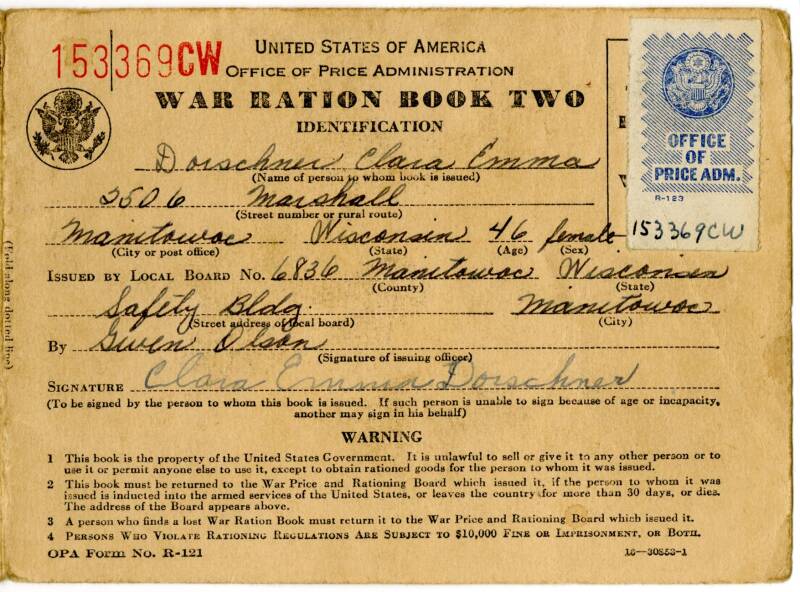
War Ration Book No. 2 (OPA)
War rationing, as mentioned before, wasn't an easy process to integrate or to understand. Many adults were confused when explained to them. During a poll in 1943, when asked about ration books, 20% more women said they understood the mechanics than men who about 50% of the surveyed population understood. Women theoretically had an upper hand when adapting, having had experience in matters of the household.
The distribution of ration cards as shown were equal in theory but not necessarily in practice. No man was allowed more points based on race or position; yet marginalized groups had a more difficult time gaining access to the materials even with money and points. As shown in the image, the ration card itself is made up of several authorizations that required strict enforcing as well as a high production value. All these factors made enforcement and management difficult in the earlier years, (Dudley, 2024)
Despite the limitations, the US citizens eventually adapted to the rationing system. In contrast to the early years of the depression, the citizens felt the presence of the federal governments; even through restrictions. Whether this was reassuring or cause for resentment, the general support for the war resulted in the eventual full implementation of rationing. In a way, rationing marks a change in US citizen involvement in global matters; bringing the US to the stage of globalization for the oncoming years.
Create Your Own Website With Webador